
Occupational Therapy and the Adolescent Years
Adolescent years bring about many changes including taking on responsibilities in the home, more demands at school, employment, driving, bodily changes, relationships, money management, increasing independence as they prepare for adulthood, and more. Occupational therapists come alongside adolescents to help support and increase their independence in these daily occupations, or everyday activities one engages in. More specifically, within the OT Practice Framework (AOTA, 2014), daily occupations consist of ADLs and IADLs. Activities of daily living (ADLs) are considered to be nine activities: bathing/showering, toileting and toilet hygiene, dressing, swallowing/eating, feeding, functional mobility, personal device care, personal hygiene and grooming, and sexual activity; whereas, instrumental activities of daily living (IADLs) encompass 12 activities that “require more complex interactions than those used in ADLs” including care of others, care of pets, child rearing, communication management, driving and community mobility, financial management, health management and maintenance, home establishment and management, meal preparation and cleanup, religious and spiritual expression, safety and emergency maintenance, and shopping (AOTA, 2014, p. S19). An occupational therapy session with this age group can include so many functional, important skills, while keeping the session fun! When working with adolescents, a treatment session might include activities such as hygiene tasks including brushing teeth, applying deodorant, nail trimming, and combing hair, dressing skills, simple household chores such as separating and completing laundry, bed making, loading and emptying a dishwasher, sweeping, or vacuuming, meal prep and cleanup, and kitchen and food safety. Other sessions might include walking to a nearby restaurant or store to complete a point of service transaction to purchase items, going for a walk outside to address environmental safety awareness, or completing simulated work tasks such as sorting, stocking, and typing for vocation/job-related skills. Moreover, when addressing ADL and IADL skills, the occupational therapist is also incorporating skills such as problem solving, organization, planning and ideation, initiation, flexibility and regulation. These skills are important and are used regularly throughout our daily activities. Regulation is also an essential skill during the adolescent years with the various changes these individuals experience. Self regulation can help work through emotional regulation, self consciousness and negative self-talk that is often difficult during these years. Ultimately, it is the occupational therapist’s goal for each child to be as successful and independent as possible in order to participate in their daily activities and fulfill their dreams and aspirations!
Orthotics
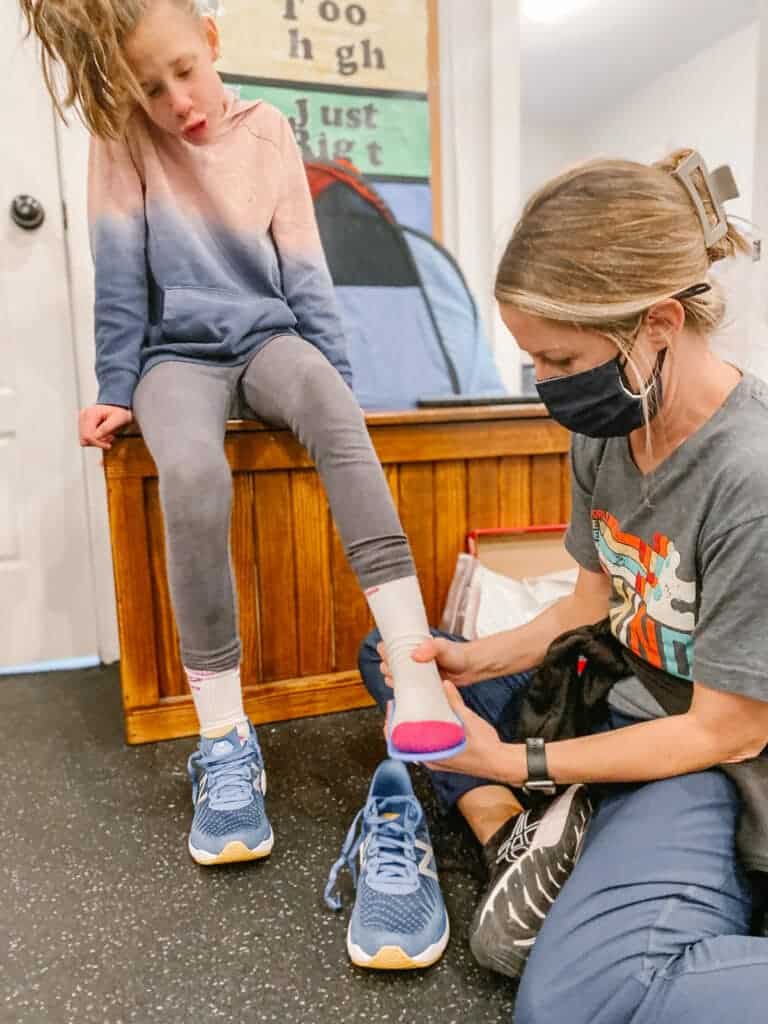
Karina Moore, PTA Orthotics are used for several different reasons and can be made several different ways. Pediatric orthotics can range from shoe inserts to knee high braces and more. According to Orthotics.pdf (pediatricapta.org) an orthosis is an external device with controlling forces to improve body alignment, improve function, immobilize the injured area, prevent or improve a deformity, protect a joint or limb, limit or reduce pain, and/or provide proprioceptive feedback. Orthoses are named for the part of the body they cover. Orthoses can be custom molded and custom fitted (custom fitted from prefabricated orthoses or off the shelf). There are many reasons why a child may benefit from orthotic intervention at all different ages, with and without a medical diagnosis. The use of orthotics can vary from child to child, however, the main goal is to provide stability while promoting functional ability. Orthotics or orthoses can be used to assist with pronation (rotation of the medial bones in the midtarsal region of the foot inward and downward so that in walking the foot tends to come down on its inner margin) flat feet, toe walking, weakness, poor balance, frequent tripping, leg length discrepancies, low tone, and structural issues. Orthotics are made to improve a child’s walking pattern to as normal for them as possible to facilitate age appropriate child development. Excessive pronation in the absence of high tone is usually easily corrected. A variety of “off the shelf” inserts are available, but may require customization. This type of insert is the one most commonly required. Sure Step is another commonly used orthotic. It’s not a fast fit product and must be measured. It offers wrap around support of the foot, assistance at the hind foot for position, and some assistance with ankle modulation. Open trim lines at the forefoot.”Surestep orthotics are custom-made to provide the extra support these amazing children need to run, jump and play. In fact, our core product, the patented Surestep SMO system, revolutionized orthotic management for children with pronation or low muscle tone (hypotonia) worldwide.” – Sure Step Physical therapists are trained in the function of orthoses and will frequently fit and measure orthoses. If the child is measured by the physical therapist, the orthoses are usually centrally fabricated and returned to the therapist for custom fitting and delivery. Following delivery of the orthosis, physical therapists provide education and functional training to the child and family. The physical therapists at No Limits are trained in serial casting, fitting, and measuring for orthoses. We work closely with the orthotists at Orthotics At Home to ensure a proper fit for the child’s best outcome. We also help educate the family on how to put on and take off along with a proper wearing schedule. If you are having concerns about the way your child walks, foot placement, or overall gross motor delays reach out to your pediatrician or physical therapist. We would be happy to take a look and help in any way we can. Orthotics.pdf (pediatricapta.org) Why does my child need orthotics? – ABC Pediatric Therapy Surestep–Dynamic Stabilizing System: www.surestep.net Cascade DAFO: www.cascadedafo.com
Articulation: When should I be concerned?

If you google articulation, there is a wealth of information at your fingertips. The problem, which data can you trust? Which list of developmental norms is the correct one? There are charts and blogs and articles that are all contradictory. IT is overwhelming, at best. As speech pathologists, we also see many confusing documents. This blog is meant to help parents have a quick, concise explanation based on research based articles and data from the national board for SLPs, ASHA (American Speech-Language Hearing Association). Here are some important facts: What is an articulation disorder??? An articulation disorder is defined as a speech disorder involving difficulties articulating specific types of sound Sound developmental milestones-it is important to remember that children can master these sounds early in age and many sounds have a time range of mastery Age 2: /h, p, n, d, b, w, m/ Age 3: /t, f, y, ng, k, g/ Age 4: /ch, l, v, dz, s, z, sh/ Age 5: /zh, r, th (“the”)/ Age 6: /th (“thumb”)/ If your child is not yet making these sounds, here are a few tips: How can you help improve your child’s articulation at home? Play: engage in play where you model and use lots of different sounds while playing (Example: “ch ch ch ch” as a train passes by, animal sounds, etc) Talk to your child throughout the dat to model correct production of sounds Reduce background noise when engaging with your child so there is less distraction Look at your child while you are speaking to them so they can see your model of words/sounds Read to your child Repeat your child’s sentence if it is not clear. By repeating what your child has said you are producing a good language model and you are showing that you have listened to what the child is saying What are activities to do at home to help improve articulation? Naming items together Copying facial expressions in the mirror Playing something together and modeling words they are having difficulties with Modeling and using different sounds during interactions (“s” for a snake sound, “shhh” the baby is sleeping) Listening to and identifying sounds in words (“sh” is the sound shoe starts with) Correcting if the child says a word incorrectly and having them repeat correct production back to you Finally, If you have additional concerns or want more information, reach out to your pediatrician. They will be able to listen to your child and determine if a referral to a Speech-Language Pathologist is appropriate. Early intervention is research based and helpful to many children who are not reaching the expected developmental milestones. If you have concerns, trust your instinct and talk to your doctor. NWA has many wonderful therapists that would love to help your child reach their highest potential. Happy Articulating! Miss Bailey and Mrs. Vanessa